Showing posts with label Mercedes. Show all posts

Mercedes-Benz ML 63 AMG (2011)

Mercedes-Benz ML 63 AMG (2011)

The subtle changes to the exterior coordinate perfectly with the high-gloss, chromed front and rear underguard, and afford the Mercedes-Benz ML 63 AMG an even more powerful and distinctive appearance. The rear, meanwhile, also contributes appropriately to the new look: the performance SUV now features darkened tail lamps incorporating a clear-lens design and LED technology. From the front, the eye is immediately drawn to the new bonnet with power domes, and the darkened bi-xenon headlamps with active light function.  The Mercedes-Benz ML 63 AMG, featuring a powerful 375 kW (510 hp) AMG 6.3-litre V8 engine, unveils its updated exterior takes on a more attractive appearance thanks to some subtle but effective changes.


Mercedes-Benz ML 63 AMG (2011)

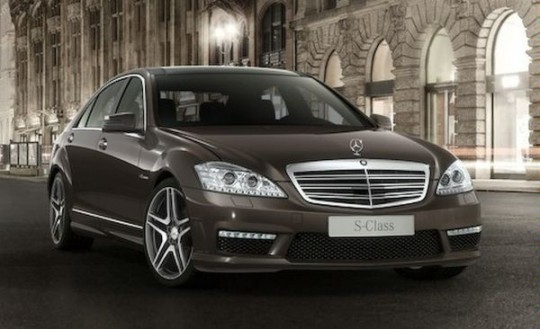
Mercedes-Benz S-Class

Mercedes-Benz S-Class (2010)

 Other innovations are the ATTENTION ASSIST drowsiness detection function and automatic crosswind stabilisation. These systems include Adaptive Highbeam Assist, Lane Keeping Assist, Speed Limit Assist and the advanced Night View Assist PLUS facility. The Mercedes-Benz S-Class's traditionally exemplary standard of safety is further enhanced by a unique combination of innovative camera- and radar-based driver assistance systems which turn the luxury saloon into an "intelligent" partner on the road.

 With an average fuel consumption of 7.6 litres of diesel, the S350 BlueEFFICIENCY is one of the most efficient models in the luxury segment. The engine range further includes eight modern petrol and diesel engines that require up to seven per cent less fuel. The fuel consumption of 7.9 litres per 100 kilometres corresponds to carbon dioxide emissions of just 186 grams per kilometre. The technology highlights include the world's first standard production hybrid drive with a lithium-ion battery in the S400 HYBRID, which makes the top-of-the-line Mercedes-Benz model the most economical petrol-engine luxury saloon.

 Trailblazing innovations in the areas of comfort and drive engineering combined with state-of-the-art technology for enhanced safety consolidate the Mercedes-Benz flagship's position as the brand's innovation driver and underscore its pioneering role in the automotive industry as a whole.  Four years after the market launch of the W221 model series, Mercedes-Benz is presenting the 2010 Mercedes-Benz S-Class.

 
Mercedes-Benz S-Class (2010)

The Mercedes Benz Supercar Cyborg Sensation Vehicle (CSV) Concept

The Mercedes Benz Cyborg Sensation Vehicle

The result is a design that takes Mercedes Benz DNA and evolves it into an organic object mimicking its pilot. Theres a lot of F400 in there but the designer wanted to give the vehicle an organic flavor, hence the muscle fibers flanking each side, neatly tucking into a hidden skeletal system. If you can put that thought aside for a second, lets focus on the design.

 The implications for such technologies means someday well know how to interpret, map out, and respond to human neural patterns. Although this principle may sound plausible in the future, its implementation on cars, could prove to be quite a difficult task. This way, the driver’s brain impulses are gathered by the helmet and transferred to the car, which responds appropriately. It uses a system named Brain Computer Interface (BCI), which creates a connection between the car and its driver, through a specially-designed helmet.

 The interesting part about this Mercedes Benz concept is that it has no steering wheel, no pedals, but this vehicle can be controlled with the power of mind instead. It foreshadows a fully integrated driver interface, providing “driving…by thinking”. Mercedes F400 concept has served as the inspiration when creating this concept car of the future. Theres no need for analog controls.

 When you sit in the drivers seat, your though patterns are sent to the vehicle, thus becoming an extension of your body. Imagine driving just by thinking. Technology and organics are bound to merge sooner or later. Its pretty obvious, (thanks Captain Oblivious) what the core concept of this vehicle is just by name. is an off-road capable, two-seater supercar, Inspired by the Mercedes F400 concept, designed back in 2001, is targeted to young adventurous professionals in 2040.

 The C.S.V.  The Mercedes Benz Cyborg Sensation Vehicle, or C.S.V., is a concept car imagined by Chinese designer Derek Chik Kin Ng.

Mercedes Supercar C.S.V Concept

Mercedes Supercar C.S.V Concept

Mercedes Supercar C.S.V Concept

Mercedes Supercar C.S.V Concept

Mercedes Supercar C.S.V Concept

Mercedes Supercar C.S.V Concept

Mercedes Supercar C.S.V Concept

The Mercedes-Benz SLS AMG GT3 is one of the biggest supercar

Mercedes-Benz SLS AMG GT3


The hood of the race model is also very The body of the 2011 SLS AMG GT3 is the most significant difference from the road car starting with the aggressive front fascia and splitter to the massive rear spoiler. This exciting GT3 version is our response to strong customer demand for a car designed for these attractive motor sports car series," says Volker Mornhinweg, Chairman of Mercedes-AMG GmbH. "Thanks to uncompromising lightweight construction and superior handling dynamics, the SLS AMG provides an outstanding basis for a highly competitive racing car. The SLS AMG GT3 is designed as a racing sports car for customers competing in sprints and long-distance races.

 Powering this race car is a 6.3-Liter V8 engine that produces 600HP and controlling all this power is a six speed racing transmission system with shift paddles mounted on the steering wheel. Front wheels are size 12×18, rear 13×18. The maximum speed was announced for 300 mph, but producers say they have more opportunities to raise her brakes are racing by AMG, as disks are ventilated. With a low weight, however, sports car accelerates from standstill to 100 km/h for only 3.7 seconds (serial sprint for 3.9 seconds). The communication of Daimler release says that “the AMG V8 engine with 6.3-liter is identical to that used in the serial sports car.

 The C-pillars provide housing for the standardized filler pipes for the fast-refuel system. The biggest visual changes are a new front apron, new splitter, redesigned bonnet with additional air intakes and vents, new sideskirts which have air inlets for cooling the rear brakes, rear diffuser and a prominent adjustable rear wing. The Mercedes SLS AMG GT3 is instantly recognizable as belonging to the SLS AMG family - as any GT3 racer is. As in the SLS AMG road car, the transmission is located at the rear axle for better weight distribution: the engine and transmission are connected by a torque tube within which a carbon-fibre shaft rotates at the engine speed. Power transmission in the SLS AMG GT3 is done through a six-speed sequential racing transmission with steering wheel shift paddles and an integrated multi-disc locking differential.

 That's all for the FIA to decide in the near future as part of the homologation process. Or even a final weight figure. There'll probably be a few modifications for the race unit, but Mercedes haven't yet announced final power outputs or specifications. The GT3 racing version of the SLS AMG is powered by the same mid-front mounted 6.3 litre V8 engine as the road car.

 But the company isn't content with just making ultra luxurious supercars for the rich and well dressed, they also plan on releasing a fully homologated GT3 race version for the gentleman racer.  The Mercedes-Benz SLS AMG is one of the biggest supercar releases of the past year.


2011 SLS AMG GT3 Mercedes-Benz

2011 SLS AMG GT3 Mercedes-Benz

2011 SLS AMG GT3 Mercedes-Benz
2011 SLS AMG GT3 Mercedes-Benz 

The Mercedes-Benz SLR McLaren revives

700HP Mercedes supercar
Mercedes-Benz SLR McLaren

Because the charger delivers its output in fractions of a second, even the most perceptive driver will not notice the When this occurs, the electronics of the engine management system trigger an electromagnetic coupling which immediately activates the compressor, which is powered by a separate poly-V-belt. Nevertheless, the system ensures that the maximum output is available as soon as the driver calls it up by stepping on the accelerator. This means that the charger is only active when it is needed.

 In order to ensure the greatest possible efficiency, the AMG engineers created an intelligent engine management system which regulates the operation of the screw-type compressor according to the engine speed and load. This means that they compress around 1850 kilograms of air into the eight combustion chambers per hour - which is up to 30 percent more than the figure achieved by rival charging systems. Despite the space-saving design, its innovative technology allows a significantly higher charge pressure than conventional mechanical chargers because the two rotors achieve a top speed of around 23,000 revs per minute, forcing air into the air inlet of the 5.5-litre powerplant at a maximum pressure of 0.9 bar. The charger is so compact that the engine specialists were able to install it between the two cylinder banks of the V8 powerplant.

 To ensure good cylinder charging, the engine has a mechanical compressor with two screw-type aluminium rotors which, in the interests of low friction losses, are Teflon-coated. Power from screw-type compressor. This means that each powerplant is the responsibility of one AMG engineer, who carries out the entire engine assembly process - from installing the crankshaft in the engine block and assembling the camshafts and the compressor to cabling. In order to achieve the highest quality, the principle of 'one man, one engine' is applied. Following the usual practice at Mercedes-AMG, each SLR engine is manufactured by hand.

 An important side effect of this technology is that, because of the dry sump lubrication, usually only used in motor racing vehicles, the engine is less tall and can therefore be installed at a lower level, allowing a low centre of gravity which benefits dynamic handling. The design of the powerplant's oil cooling system is also based on experience gathered in the world of motor racing: a sophisticated dry sump lubrication system with an oil capacity of around eleven litres, combined with a five-stage oil suction pump and a two-stage oil pressure pump, ensures reliable lubrication under all on-road conditions. The maximum of 780 Newtonmetres is available from 3250 rpm and remains constant in a broad engine speed range up to 5000 rpm As the figures indicate, the new SLR is endowed with what is currently one of the most powerful engines to be found in a series-produced roadgoing sports car. The result is impressive: from a mere 1500 rpm, the SLR powerplant delivers torque of over 600 Newtonmetres, rising to 700 Newtonmetres at 2000 rpm.

 After an extensive concept phase, they decided in favour of an 8-cylinder design with a 5.5-litre displacement, a cylinder angle of 90 degrees, a screw-type compressor and a crankshaft supported by five bearings. When developing the powerplant, the AMG engineers applied both the expertise they had acquired during their three-decade involvement in motorsport and the stringent standards of the Mercedes-Benz brand. Engine and Transmission. Water-type charge-air cooling, three valves per cylinder, dry sump lubrication and four metal catalytic converters are further special features of this powerful engine - an engine which already meets stringent EU 4 exhaust gas regulations which are not due to come into force until 2005.

 The V8 powerplant is mounted on a robust aluminium frame and has a low installation position. In the interests of optimum weight distribution, optimum dynamic handling and high stability on braking, the Mercedes-Benz SLR McLaren has a front mid-engined design. The two-seater has a top speed of 207 mph (334 km/h). With this kind of power under the bonnet, the Mercedes-Benz SLR McLaren delivers performance figures which are among the best in its class: this high-performance sports car takes just 3.8 seconds to sprint from 0 to 100 km/h, it passes the 200 km/h mark after 10.6 seconds, and from a standing start it takes just 28.8 seconds to reach 300 km/h.

 With its 5.5-litre displacement and screw-type compressor, the engine develops a peak output of 460 kW/626 hp and delivers its maximum torque of 780 Newtonmetres from 3250 rpm - a figure which remains constant across a broad engine speed range of up to 5000 rpm. For evidence, simply take a glance under the bonnet at the Mercedes-AMG V8 powerplant. Just like its legendary predecessor of 1955, this SLR incorporates new technological developments which are ahead of their time. These attributes come together to form the basis for an automobile with a very special charisma - an impressive synthesis of Mercedes tradition and innovation in every respect.

 This combination of knowledge and expertise is evident not only in the host of pioneering developments, impressive performance figures and superior driving characteristics of the SLR, but also in the extremely high levels of safety and practicality which it offers. The new super sports car allows Mercedes-Benz and its Formula 1 partner McLaren to showcase their collective experience in the development, construction and production of high-performance sports cars. A contemporary interpretation of stylistic elements lifted from the original SLR and design details taken from the 2003 Formula 1 Silver Arrows allow the 21st-century SLR to form a bridge between the past and the future, bringing cutting-edge motorsport technology to the road, just as the inspirational SLR Coupe did in 1955. It is a passion which can be traced way back through automotive history and which was demon-strated with the Uhlenhaut Coupe.  The Mercedes-Benz SLR McLaren revives the glorious tradition of the SLR and marks the reawakening of Mercedes-Benz' passion for super sports cars.


Mercedes-Benz SLR McLaren
Mercedes-Benz SLR McLaren Volcano

Mercedes-Benz SLR McLaren Hamann Volcano
Mercedes 700HP SLR supercar
Mercedes-Benz SLR McLaren
Mercedes SLR supercar
Mercedes-Benz SLR McLaren
Mercedes 700HP SLR
Mercedes-Benz SLR McLaren
Mercedes SLR

Mercedes-Benz Shooting Break Concept Surf

Mercedes-Benz Shooting Break Concept (2010)

a crossover between these two worlds – is considered a shooting break. The only sign of the new engine tech visible from the outside, the dual exhaust tips integrated into the rear bumper. With spray-guided direct injection systems, piezo-electric injectors and stop-start technology, Mercedes says the 60-degree angle 3.5-liter V-6 306 hp, 273 pounds-feet of torque will produce.

 Instead, there’s what is said to be a precursor of the next generation of V-engine Mercedes. Unlike the F800-style approach, there is no fuel cell or hybrid technology under the hood of the Shooting Brake concept hides. The light system is expected to be available in production cars later this year. The dynamic LED lights take 71 units and offers five modes: Country lighting, lighting highway, enhanced fog lamps, active bend lighting and cornering light when Bi-Xenon lights.

 Shooting Break Mercedes has new Intelligent Light System.  Of course, Mercedes Car showcase a wide range of next-generation technologies coming soon to a showroom near you.

Mercedes-Benz Shooting Break Concept
Mercedes-Benz Shooting Break Concept (2010)
Mercedes-Benz Shooting Break Concept Interior

Mercedes-Benz SLS AMG F1 Safety Car in action

 Mercedes-Benz SLS AMG F1 Safety Car (2010)

Pure The installation position a long way behind the front axle and the transaxle arrangement of the new seven-speed double-clutch transmission on the rear axle have a positive effect on the weight distribution, which is 47/53 percent (front/rear). And thanks to the dry-sump lubrication system, the AMG V8 powerplant can be installed very low down, resulting in a beneficial lowering of the vehicle’s centre of gravity. The unique vehicle concept is a key factor in ensuring outstanding driving dynamics: the aluminium spaceframe body keeps the vehicle weight down to 1620 kilograms (DIN kerb weight).

 Fast lap times are a must for the Official F1 Safety Car, otherwise the Formula-1 cars’ tyres and brakes would cool down too quickly, while their engines could overheat. Unique vehicle concept for maximum driving dynamics The Mercedes-Benz SLS AMG has the best possible credentials for this demanding role in the top flight of motor racing: its 6.3-litre V8 engine has a peak output of 420 kW (571 hp) and a maximum torque of 650 Nm, enabling the gullwing model to sprint from 0 to 100 km/h in 3.8 seconds. When radioed by Race Control, the former DTM driver and his co-driver, FIA man Pete Tibbetts (44, from the UK) will take to the track at the head of the field in order to guide the Formula-1 race cars safely around the circuit. The SLS AMG, piloted by Bernd Mayl nder (38, from Germany), will be on standby in the pit lane throughout the entire race. From March 2010, the Official F1 Safety Car will be deployed whenever hazardous situations such as accidents or bad weather endanger normal racing.

 I’m sure all Mercedes and AMG fans will be excited to see the gullwing model together with the new Mercedes GP Petronas Team at the F1 circuits,’ says Volker Mornhinweg, Chief Executive Officer of Mercedes-AMG GmbH. ‘Together with the entire AMG Team, I am very proud that the new SLS AMG is the official F1 safety car. As in the last two years, the C 63 AMG Estate will be used as the Official F1 Medical Car for the coming season. The ‘gullwing’ model replaces the SL 63 AMG, which was used as the Official F1 Safety Car in 2008 and 2009. The job of the new Mercedes-Benz SLS AMG, which will be launched on 27 March 2010, is to ensure maximum safety in Formula 1.

  * Gullwing model for motor racing’s top flight * Unique super sports car concept * Two monitors for keeping a close eye on the race * C 63 AMG Estate once again Official F1 Medical Car When the new Formula-1 season gets underway in Manama/Bahrain (12-14 March 2010), it will mark the debut of the most spectacular and powerful Official F1 Safety Car of all time.


Mercedes-Benz SLS AMG F1 Safety Car (2010)
Mercedes-Benz SLS AMG F1 Safety Car


Mercedes Arrow Is A Lightweight Two-Seater Vehicle Gives You The Feeling Of Sliding With A Bobsleigh

Mercedes Arrow has been designed to draw a comparison with other recreational vehicles such as motorcycles, jetskis or personalized aircraft. This stunning vehicle gives its passengers the ride of their life. The bobsleigh shaped body, the lightweight materials and the sporty look enable it to shoot through heavy traffic like an arrow from a bow. This experience can only be enjoyed by two passengers, their seats are placed one in front of another. One of the stunning features this futuristic car has, is that it combines TANDEM with MAGLEV technology to take sharp corners. This innovative feature allows the body of the car to tilt left and right when the car is taking corners, thus minimizing the wheels tilt angle. There is an almost non-existing chance for the vehicle to slide out of control. Due to the slim body, the wheels cover the same space of tarmac, just as a contemporary car, eliminating the risk of the car flipping over. The designer, Felipe Palermo, found inspiration in the old Silver Arrows, the SLR McLaren and the 1954 Gull-Wing.

Designer : Felipe Nogueria Palermo

Mercedes arrow concept6

Mercedes arrow concept7

The whole design and idea put this concept automotive in a near future, where people won’t be using cars anymore. A future where the whole transport itself will be based on rail systems. Felipe’s Arrow vehicle is designed for fun in the weekends, a recreational vehicle. The air intake placed in the rear of the car, over the last passenger, reminds us that the whole vehicle is based on Mercedes’ racing history and its super-cars. The airintake is also a starting point for the side bars, which strengthens the body and hold between them a small wind shield in front of the driver. Mercedes Arrow will be equipped with the next generation tire technology. They will have the ability to never wear out, the driver will be able to re-inject them with rubber and take the car for a spin, again. Felipe Palermo has applied everything he has learned at the IED, where he graduated in Car Design in 2007. He also has a post degree in Transportation Design and Industrial Design at FAAP, and is currently working at Mercedes-Benz Design Studio in Brazil.

Mercedes arrow concept8

Mercedes arrow concept9

Mercedes arrow concept4

Mercedes arrow concept1

Mercedes arrow concept2

Mercedes arrow concept3